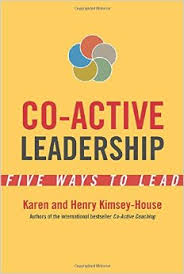
Co-Founders of CTI (Coaches Training Institute) Karen and Henry Kinsey-House have written a slim volume on Co-Active Leadership that introduces one aspect of a much deeper subject. Co-active is all about being active together. Co-active Leadership is also the name of the 10 month program that I participated in over 5 years ago. My main concern with this book is that readers will think that this shallow treatment is as deep as it goes.
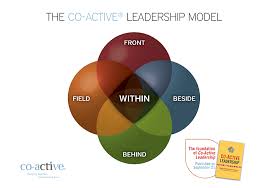
The Co-Active Leadership model is a venn diagram with “Leader Within” where the circles intersect. The four circles are:
Leader in the Field
Leader in the Front
Leader Beside
Leader from the Back
Most people associate leadership with the classic front of the room leader. The authors help to expand the definition of leadership by explaining the other roles that leaders can play and by asserting that everyone is a leader. The best leaders are flexible.
The book is a quick read at just over 100 pages–I read it on the flight home from Miami.
The trust fall is a classic “trust building exercise”. Real trust is built in a 1,000 interactions.
When I read Stephen M.R. Covey’s The Speed of Trust several years ago, I experienced one of those delicious moments when you read something you have experienced but never seen articulated. The basic premise is that when trust is present it is possible to save time and money in business; and the lack of trust results in increased costs and lost opportunity. I have shared it with several teams I work with and we all agreed that one area where the Covey book falls down is in practical advice on how to build trust. There is a long list of behaviors that build trust, but it is difficult to remember 24 or more ideas.
Then I discovered Charles Feltman’s The Thin Book of Trust. It is all about practical advice for building and maintaining trust in the workplace.
Sincerity – I mean what I say, say what I mean, and act accordingly.
Reliability – You can count on me to deliver what I promise!
Competence – I know I can do this. I don’t know if I can do that.
Care – We are in this together.
There is an excellent chapter on making more effective requests and responding effectively to requests.
“When you make a request of someone, in addition to making sure you have all of the elements clear in your request, check to be sure you are fully committed to what you ask for. For example, if you ask someone to do something by the next day, when you really don’t need it until next week, or worse yet don’t need it at all, that person is likely to begin to distrust your competence, your sincerity or both.” (p28)
My favorite chapter is 7. Confronting Distrust. Feltman gives you good advice on how to prepare for a more effective conversation when someone has damaged trust and restore the relationship.
The Thin Book of Trust, at less than 70 pages, makes a great homework assignment for a team. There are discussion questions.
As to the behaviors that destroy trust, I rely on a book on marriage. It may seem unlikely to have any transferable application. John Gottman’s book The Seven Principles for Making Marriage Work details the “Four Horseman” that destroy respect and trust: criticism, contempt, defensiveness and stonewalling.
These three books make up the 3 pillars of trust literature.
Colleen calling me forth as Invisible Woman has focused my thinking about what it means to be a Superhero Woman. Our culture would likely use descriptors such as sexy, successful in a career AND motherhood, well dressed and well coifed, a great entertainer, and a great friend. I have a different set of criteria that allows for much more diversity.
Serena Williams possesses all three traits and is a superhero woman.
Authentic. She is her authentic self. She is comfortable in her own skin and has largely overcome the tendencies to be a people-pleaser or nice. If she is loud, she is loud without apology, or shy, or seriously smart, or funny.
Overcomes Social Conditioning: This may seem related to being authentic but it includes learning to love yourself as you are. The biggest challenge most women face is loving their bodies as they are created and includes accepting the aging process without self-judgement.
Laurelin Gilmore: Be your own hero, be your own bad girl.
I recently bought two paintings by Laurelin Gilmore that captures the idea of women claiming their space without excessive regard for what others think. As the artist wrote about her work, “I was in a conversation with a friend who works as a personal trainer… I told her I don’t want to build muscle, but slim down, get smaller. She was understanding, clearly having heard this before, but she is not interested in helping women get smaller, helping women shrink. She said she wants women to take up more space. She said we, as women, are already made to feel small, want small. She told me not to be afraid to gain in volume and take up more space.”
Laurelin Gilmore: Take your seat at the table and fill it up.
3. Exercises Her God-Given Talents and Gifts. God in his/her infinite creativity does not limit what women can do. A Superhero Woman does not question her passions, gifts and talents but grabs them with both hands and enjoys them.
My CTI Leadership tribe mate and friend, Colleen O’Rourke, wants to fill Facebook with comic book heroes to fight the saturation of negative images and videos. She said, “Give me a like and I’ll assign you a character.”
I am not familiar with many super heroes. For example, I never heard of Ant Man until the recent movie came out, and even then I suspected it was a spoof (not). So when Colleen assigned Invisible Woman/Sue Storm to me I wondered why.
Colleen explained: “I have finally decided on Invisible Woman for a couple of reasons, but the most is that her power is not one of aggression or injury. She doesn’t strike down, she protects. She uses her powers to work with what is in the environment to influence the outcomes, and does so without causing injury. This, along with her intelligence, is why I picked her for you. Here is the description I liked: Invisible Woman uses her powers for both offense and defense, and is the heart of the team, guiding them through hardship and being the voice of reason when arguments get heated.”
Wow. It resonates with me, especially because I do not like being in the front of the room. I claim my superpowers. Thank you Colleen.
Brene Brown is the author of a trilogy of “Self Help” books that will rock your world.
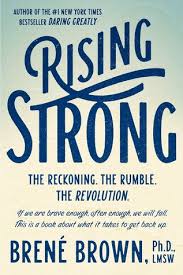
Brene Brown’s Rising Strong completes her trilogy of books on overcoming shame and living wholeheartedly. Each book builds on the next and is grounded in her research. Rising Strong is a powerful book; however, it should come with a warning label. “Shit storm will inevitably ensue as you read this book.”
If you read the book in any kind of earnest you will reaffirm your commitment to living wholeheartedly and as a result you will better define your boundaries and stay in touch with your emotions. Ultimately this will clash with someone else’s expectations or values in variance with yours. Someone you care about. Let me explain with my own story.
I received Rising Strong as a gift from my dear friend Mara V. Connolly who is an executive coach trained in the Daring Way. She knows I am a Brene Brown enthusiast and it was a delightful surprise to open an unexpected Amazon package and see her note. I was heading to Los Angeles so I tucked the book in my bag and began reading it almost immediately.
I was only a few chapters in when I found myself triggered and face down in the dirt. While still in the whirlpool of embarrassment and hurt, I sent an angry, hurt-you-back text to the person in my “Rumble” in the cab rushing from to the airport. I risked airsickness while I wrote what I called my “first story” in my journal on my Southwest flight home. The next morning I realized that I needed help and I reached out to Mara to process.
Over the next few days I figured out what triggered such a strong emotional reaction and the values that were stepped on. This helped me get clear about what new boundaries I needed to set with the friend in the Rumble. I wish I could report that my friend and I were able to be curious about each other’s triggers and clear. It did not go down that way and I have been processing the heartache that comes when a relationship is not what we hoped.
As I read the rest of the book I kept referencing my Rumble. It was such a powerful learning opportunity. I especially struggle with the question, “Are people in general doing the best they can?” This cracks open my own harsh self-judgement for the times when I stumbled and did not live up to my own standards. Was I doing the best I could in that moment when I sent the angry text? I do not think so.
The key to the question is “in general”. I am not asking: are people infallible? Instead I am choosing a more compassionate life philosophy. If I assume that people are in general doing the best they can in this moment, then I can extend grace and live life more wholeheartedly, that is a life defined by courage, engagement and clear sense of purpose.
This assumption that people are doing their best first came up when I was coaching with Marj Plumb. The CTI Co-Active Coaching curriculum says every client is creative, resourceful and whole. I remember really challenging this with Marj. What about the people who are mentally ill? And Marj encouraged me to continue to start from the assumption that people are doing their best. Like forgiveness, starting from this place of grace and compassion is as much for my own benefit as the other person’s.
If I assume that I am doing my best, I can be curious about my own triggers and extend grace to myself. This does not mean I never need to repair with someone for something I said thoughtlessly. It does mean I can lay down that incident as a lesson learned instead of continually using it as a lash to whip myself for my inadequacy. And get on with the business of leadership.
I wish our society was not so celebrity obsessed. It has some obvious negative consequences (Exhibit A: Donald Trump for President). It also chews up and spits out individuals. The movie Amy about the late soul singer Amy Winehouse was hard to watch as a beautiful and talented young woman was chewed up and spit out by the celebrity entertainment machine. The people surrounding her, including her husband and father, were more interested in exploiting her than in protecting her.
Amy Winehouse
We think of celebrity as a modern phenomenon intensified by social media and 24 hour news cycles. Recently I read two biographies—one about the Wright Brothers and one about Charles and Anne Morrow Lindburgh. All were famous for achieving something brave that captured the public’s attention. And as a result, all were subject to an intense amount of public and press attention.
For the Lindburghs, it was often suffocating and tragically resulted in the kidnapping and death of their first child. Journalists did not let up in spite of the tremendous impact of their collective actions. The kidnapping was in the early 1930s—well before television. Yet the willingness of journalists to trample on their privacy for a story or a photo was relentless.
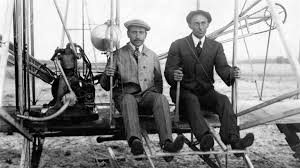
Wilbur and Oroville Wright
Even earlier in history, Oroville and Wilbur Wright invented flight in 1904. They toiled away at Kitty Hawk, North Carolina in obscurity for several years and then caught the public’s imagination with their aerial demonstrations. People in Europe and America could not get enough of the Wright brothers. According to biographer David McCullough, they handled the pressure and attention extremely well without letting it change them.
This can be attributed to the wisdom of their father, Bishop Milton Wright.
He was a steadying influence on his 5 children including Wilbur and Oroville. The Bishop liked to preach the futility of craving fame. “Enjoy fame ere its decadence, for I have realized the emptiness of its trumpet blasts.” He had written Wilbur, and quoted favorite lines from the Irish poet Thomas Moore:
And false the light on glory’s plume
As fading lines of even.
David McCullough, The Wright Brothers New York: Simon and Schuster, 2015, p. 188.
Once upon a time people did not seek out fame as an end in of itself. Celebrity used to be connected to achievement. David Brooks in his book, The Road to Character, decries the change from the culture of humility to the culture of the Big Me.
It wasn’t hard to find such data. For example, in 1950, the Gallup Organization asked high school seniors if they considered themselves to be a very important person. At that point, 12 percent said yes. The same question was asked in 2005, and this time it wasn’t 12 percent who considered themselves very important, it was 80 percent.
David Brooks, The Road to Character, New York: Random House: 2015, page 6.
I remember when I was managing and employee in the advent of reality television. At the time there was only MTV shows and Survivor. I asked him about his career goals and my mouth dropped open when he said that one of his goals was to be a reality tv star. I think I may have even said, “That is not a career goal.” My statement was very out of touch to the new realities, but like my grandparents with their “I remember when bread was a nickel.” I remember when fame was connected to some real achievement.
Are we at the apex of the Big Me? How will we recover? This is one of David Brooks’ motivations for writing The Road to Character. He wanted to provide profiles of what he sees as real leadership in the same way a chef wants to give us real homemade food to put the instant processed food in context.
How else can we raise the flag of leadership in service of others?
Speaker and author Jon Acuff’s most recent bestseller is Do Over. This book gives solid advice about how to get unstuck in your career. You may not find any new ideas for a Do Over if you have been forced to recover from a layoff or have successfully rebooted your career; however, he gives an ample helping of good career advice and his sense of humor makes the book easy reading.
Jon introduces the concept of a Career Savings Account (CSA). He structures the book around building your CSA and then activating it when you need it to make a move.
Career Savings Account = [Relationships + Skills + Character] x Hustle
Business and career writers are compelled to create a matrix or two to lend an air of expertise to their advice. Jon’s matrix is all about the typical reboots needed in a Do Over.
Jon Acuff illustrating a point.
Acuff has good ideas for all of the elements of a CSA, especially hustle. Indeed I have participated in Jon’s “30 Days of Hustle” support group on Facebook. In this post, I am focusing on the role of character.
Character is a recurring theme in leadership literature but is often given short-shrift in business and career advice. It is not easy to help people without it to get some when a crisis hits. And in our capitalist system there are more rewards for the character-challenged, at least in the short term.
There are many challenges to building and maintaining character. First of all, what is considered “character” is fuzzy and there are not a large number of traits that everyone agrees are pillars of good character. Like many things it seems to fall into the squishy category of “I know it when I see it.” Or, “I know the lack of character when I experience it.”
Recently I watched the documentary Slaying the Badger on Netflix. It tells the story of Bernard Hinault and Greg LeMond, two teammates who competed for the yellow jersey in the Tour de France in the mid-1980s. Normally there is one team leader in cycling and the team’s agenda is to ensure his victory for the general classification. Climbing and sprinting stars are expected to pursue their personal goals only after the team leader’s goals have been served. Most of 9 team members are called “domestiques” because of their servant role. Bernard Hinault was showing signs of weakness in the 1985 Tour de France and his young teammate Greg LeMond who was the stronger rider that year was ordered to continue to serve the team leader rather than pursue the personal glory that was within his grasp. It was widely understood by the press and other teams that probably some deal was struck whereby the following year Hinault would work for LeMond’s victory. But in 1986 Hinault was feeling stronger and he essentially backed out of his deal. He justifies it in many ways, such as “There are no gifts (give away wins) in cycling.” Ultimately his character was revealed. Depending on your values you admire Hinault for his competitive spirit or you frown at his inability to keep his word.
One of TheFour Agreements (Don Miguel Ruiz) is “Be impeccable with your word.” This is a hard standard to keep and yet one of a highly prized character traits among many people. Quakers have a Testimony of Truth that is essentially the same: let your yes be yes, and your no be no.
The challenge is to do the work to figure out what elements of character matter to you and to make the long-term investments to make these non-negotiable in your life.
I spent a lot of time in my 20s and 30s holding everyone to my standards and being crushed when people did not honor my code. When I participated in the California Agriculture Leadership Program I was bewildered by smart and capable people not seeing the same fatal flaws I could see in other people’s characters. In the same leadership program we met with Leon Panetta while he was serving as President Clinton’s Chief of Staff. I remember him saying that you have to act in such a way that you can look at yourself in the mirror and have no recriminations or regrets.
I returned to that wisdom over the years as I learned from experience that there is no way we can reach a consensus on these values in such a diverse society. It has helped me to hold true to myself when under pressure.
If you are having the nightmare where you get to class and discover there is an exam that you forgot and did not prepare for and you are way past school age, then you need to learn to manage the particles. At the World Domination Summit, Jon Acuff recommended David Allen’s book, Getting Things Done. I jotted it down in my notes and downloaded it later in Kindle. At one point in my life I had that nightmare on a recurring basis with a twist: I forgot that I was enrolled in the class and had not attended most of the semester.
I no longer have this dream because I have created systems that help me manage the particles. In the CTI Co-Active Leadership Program they challenged us to not put too much energy into managing the particles. Our trainers were concerned that we would substitute a focus on details for leadership that sees the big picture. You can carefully care for your calendar and never drop a ball, but without a clear leadership stake and a strategy for accomplishing it, and then the details are just particles. They admonished us to do more than manage the particles.
However, if you do not have a way to manage the particles they will undo your leadership. As Allen says:
“Managing commitments will requires the implementation of some basic activities and behaviors:
First of all, if it’s on your mind, your mind isn’t clear. Anything you consider unfinished in any way must be captured in a trusted system outside your mind, or what I call a collection tool, that you know you’ll come back to regularly and sort through.
Second, you must clarify exactly what your commitment is and decide what you have to do, if anything, to make progress toward fulfilling it.
Third, one you’ve decided on all the actions you need to take, you must keep reminders of them organized in a system you review regularly.
You must use your mind to get things off your mind.”
Getting Things Done, page 14
If this resonates and you could use a system for tracking your “open loops” and identifying your priorities, then read Getting Things Done. If you have figured out a system that works for you, then carry on and give this book a pass.
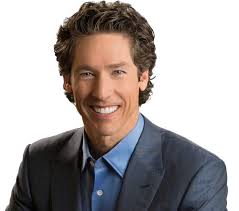
What does Joel Osteen have in common with Donald Trump?What does Donald Trump have in common with Joel Osteen?
One of the inspirations for starting this blog was the teaching I received from Rob Bell and Richard Rohr on spiral dynamics. I was so intrigued by this concept I dug out other books I had read, such as Real Power by Janet O. Hagberg. I ordered Transformations of Consciousness by Wilber, Engler and Brown and intended to read it. My first posts were going to be my synthesis of these ideas and its usefulness as a tool for leaders.
Then life intervened and a few people who are important to me did not react very positively when I shared the new ideas I was mulling over. It could just as easily have been my poor presentation, but it shook my enthusiasm.
I set this project aside and got busy with other projects. And then Donald Trump announced his candidacy for President of the United States and his popularity completely mystified me. WTF?
I hoped he would flame out with each new absurd pronouncement. He got away with his ridiculous statements about Mexicans with a few canceled contracts. Then surely his criticisms of John McCain would self-destruct his campaign. Instead his popularity went up. WTF?
Then I witnessed the Trump phenomenon up close while I was bicycling across Iowa with RAGBRAI. In spite of his criticisms of John Kerry’s bicycle riding proclivities, his campaign sent a Trump bus and volunteers to dog the route each of the 7 days. This inspired two extreme reactions. Either his campaign bus got cheers and a thumbs up or jeers and the finger. No one was indifferent. It was impossible to tell the numerical balance without spending a lot of time near the bus. (I had a visceral negative reaction.) I realized then that I had to spend some time figuring out how anyone could be enthusiastic about his candidacy. My teammate Barb had the same idea and she pedaled hard to catch up with a woman who cheered only to learn that this woman also loved Sarah Palin. Barb drifted away wondering WTF?
This led me back to the theory of spiral dynamics and a possible explanation.
It is dangerous to explain spiral dynamics in a nutshell; however, this is a blog and not a 323 page book, so I will attempt to do it justice. First, it assumes that there are levels or stages of consciousness and that people grow in their consciousness through life experience and especially through suffering. Similar levels of emotional maturity have been developed by various psychologists. It is not a perfect lens but it offers insight. (If the word consciousness makes you buggy then think spiritual and emotional maturity.)
Rob Bell and Richard Rohr presented spiral dynamics in two tiers and with several levels on each tier. They assigned them names, numbers and colors. The first level begins the kind of chaos–emotional and social–frequently associated with toddlers, addicts and sociopaths. The focus is on the individual in level one. Hopefully you quickly mature or recover to the second level with a community focus. People in level two are strongly identified with their tribe and relate to God with mystical or magical thinking. They do not see themselves as able to set goals and go out and accomplish them and the setbacks they experience feel random and like the gods must be angry.
Level three is sometimes called “power” and this is because level three people again regain their individualistic outlook. They learn they can harness their personal power and accomplish goals they set and sometimes lead others. If you stay in this level you can become very egotistical. You also can call forth level two people who aspire to be more like the level three leader. When Rob Bell presented level three he used Joel Osteen as an example of a level three religious leader calling forth level two people (in a benign way).
My best explanation for Donald Trump’s popularity in the presidential race is that he is a level three leader and there are a lot of level two people who find him inspiring. (Either that or it is the natural human fascination with car crashes and train wrecks.)
Which leads me to question, how many level two people are there? Well 43,500 people attend Joel Osteen’s church each week in Houston. A lot apparently.
There are more levels and the point of Rob and Richard’s seminar was to help people understand it and inspire them to lead from the Second Tier.
Level four is a community-outlook again. The movement from individual to community to individual to community is what gives the upward progression of consciousness its spiral twist. Level four has traditional, hierarchical values. The evangelical church in America today is very level four with its male-dominated leadership.
Level five is individual-focused and values technology and modern analytical ways of thinking about the world. It is also where most atheists reside. As a political scientist I could see a parallel with the traditional level four (greatest generation) winning World War II only to be overtaken by the technocratic McNamara’s of the world running the Vietnam War using statistics.
Level six is once again community oriented and post-modern. Many millennials living on the coasts have matured into a society with this as the predominant consciousness. Everyone has a story and everyone’s story matter–yours as much as mine.
The next level is in a second tier and requires a jump in consciousness. While it changes back to an individual focus again it is with the ability to see all of the levels with compassion. In the first tier, lower level people looked ahead with fear at the others and higher level people looked back with disdain. The second tier people know that we have the ability as humans to be tribal and can be called forth to honor others’ stories or to acts of compassion.
There are additional levels in Tier Two but it becomes vague since so few people achieve it. Think Nelson Mandela, Martin Luther King, Jr., Ghandi. Rob and Richard hope that more people will aspire to raise their consciousness, especially leaders, so we can cope with the unique challenges that lie ahead.
There is a lot more to unpack in spiral dynamics and I will return to the topic. Meanwhile, for me, it is the best explanation of the Donald Trump phenomenon. And my puzzlement and sometimes disdain is a signal that I have not evolved to Tier Two yet.
The journey continues.
PS. I do not recommend Transformations of Consciousness as it is much too technical tomb of psychology. I will keep looking for a better explanation of spiral dynamics.
Warning: If you keep Jon Stewart on a pedestal and only like reading high praise for the man, stop reading now.
Jon Stewart is filming his last show today and a lot of journalists (Fresh Air, NY Times, etc.) are covering this event. I have a routine of watching the previous day’s show on the internet over lunch and Jon Stewart is the only anchor I have known on The Daily Show. I miss the Colbert Report because it went away entirely. I hope when Trevor Noah takes over I will remain enthusiastic about watching it over lunch.
I marvel at his intelligence and wit, but I have occasionally witnessed his thin skin showing through when he interviews guests or is parrying attacks from Fox News and others. And then I listened to Marc Maron’s podcast interview with former Daily Show correspondent Wyatt Cenac. He tells his story about the incident that ultimately led to his leaving the Daily Show. He expressed a difference of opinion to Jon Stewart about how Stewart chose to respond to an event. Cenac’s opinion was informed by his experience with race as a black man in America and unfortunately Stewart took it personally and responded in anger (perhaps rage).
And then Stewart did not repair with Cenac and so ultimately Wyatt Cenac found working at the Daily Show so uncomfortable he left the show.
First, I want to share that I have done the same thing (losing it to the point of screaming) to an employee of mine. And I eventually learned to feel truly sorry. It took about 4 months of executive coaching before I could recognize how damaging what I did was to the other person. By that time my employee had moved to the other side of the country for a new job and my team had gone through hours of team building using tools from John Gottman’s research. I never repaired with the individual though.
I am not proud of this fact. And having experienced this lapse in my leadership, I have compassion for Jon Stewart and have an idea of why he may not have been able to repair his relationship with Wyatt Cenac.
I also know that leaders repair relationships. It was a much longer journey to really learn this lesson. It was only when I had experienced CTI’s Co-Active Leadership Program that I locked in the learning about how to clear with people and keep relationships in good trim. It takes a lot of conscious effort and it means I have to deal with my own “stuff” (and by stuff I mean shit).
Maybe this is part of Jon Stewart’s decision to leave. Maybe he does not feel his current job gives him the bandwidth to deal with these personal issues. We have no way of really knowing; however, I can still learn from the WTF podcast interview. I do not think Jon Stewart is a racist or a rage machine, just as I am not the sum of my episode with my employee. And this is the same Jon Stewart who did the delightful interview with Ta-Nehisi Coates. I wish him all the best and I will still miss him.

 The Co-Active Leadership model is a venn diagram with “Leader Within” where the circles intersect. The four circles are:
 Most people associate leadership with the classic front of the room leader. The authors help to expand the definition of leadership by explaining the other roles that leaders can play and by asserting that everyone is a leader. The best leaders are flexible.







 leader's compass