I have experienced the boost in productivity that being organized gives and the distraction that clutter creates. Many times I procrastinate by sorting and filing until it is back in order. I have read many books about organization, but none quite like Marie Kondo’s The life-changing magic of tidying up: the Japanese art of decluttering and organizing.
My newly mostly-empty guest closet with boxes.
Direct quotes from the book are in bold.
Start by discarding. Then organize your space, thoroughly, completely and in one go. …when you put your house in order, you put your affairs and and your past in order, too.
To truly cherish the things that are important to you… Keep only the things that speak to your heart. (that bring you joy)
This is not as hard as it sounds. Most of Kondo’s clients take dozens of bags to the trash or to charity. I have already decided to sell 2 bikes and have donated 6 bags to Good Will and I have just begun. It feels good.
It is about being mindful in your living space.
People have trouble discarding things they could still use (functional value), that contain helpful information (informational value), and that have sentimental value (emotional value). When these things are hard to obtain or replace (rarity), they become even harder to part with.
The best sequence is this: clothes first, then books, papers, komono (misc.), and lastly, momentos.
I cannot go through my books until after Christmas. Many of them are being deployed as my Christmas tree.
I am not strictly following this order because Sarah Harriet is helping me. She is concentrating on my komono and I am going through clothes. She advises thanking the clothes you are discarding for their service. It feels a little weird at first, and oddly enough, it makes it easier to let them go. My goal is to finish the process by the end of the year, thus making room for new adventures in 2016.
The question of what you want to own is actually the question of how you want to live your life.
Life becomes far easier once you know that things will still work out even if you are lacking something.
As for you, pour your time and passion into what brings you the most joy, your mission in life.
This Advent season I am motivated to glean the stuff, and the commitments that no longer serve me. I am making room for new adventures and new challenges in 2016.
I am also examining my beliefs to see if there are any self-defeating thoughts that can be put on the curb. This video has been a powerful reminder to me of truths I learned in CTI Co-active Leadership training. Especially at a time when people in our communities are acting out of fear.
Dr. Nick Hall’s thesis is that we do not control our circumstances, but we do control our own mind. Achieving our goals will depend on our beliefs. Our conditioning based on these beliefs can also undermine our attempts to achieve our goals.
The good news is we can change our beliefs. Step one, identify a belief. What do you believe? Step two, ask these three questions:
Is this belief justified?
Is this belief serving a useful purpose?
Does it make me feel good?
This process is very liberating because the first step starts you on a journey towards choice and freedom. Most of the time we are operating on autopilot on beliefs–and they do not always serve us or our goals. In a recent Bloomberg interview, Michael Moritz of Sequoia Capital. “When asked about Sequoia’s lack of women, Moriz said they were looking to hire more. But ‘what we’re not prepared to do is lower our standards,’ he said.” (from Upworthy article)
His statement reveals his beliefs that women are not as capable as men. As long as he does not examine this belief and ask Hall’s three questions, he will not achieve his goals of hiring (and retaining) women employees.
Hall offers more insights in the video and in his two books:
During today’s lunch hour I watched Global Immersion Project’s webinar, “Confronting the Refugee Myths.” If you missed it, you can watch it here. After catching up on a few tasks I realized that it was after 2 and I scooted over to Plates2Go to get a sandwich.
I mentioned to the woman serving me that I was running late because I listened to a webinar on welcoming refugees. Her response summed up the challenge in a nutshell: overcoming fear. She said she is afraid that by letting in refugees we are letting in terrorists. I replied that I understand it takes courage but that our screening process makes it almost impossible for a terrorist to infiltrate. (I could have mentioned that Jeremy from Preemptive Love Coalition says we should be more worried about homegrown radicals, but I wanted to dial down the fear not amplify it.) Then she told me about a friend in law enforcement that told her about the theft of over $39,000 worth of UPS uniforms. She is concerned that this is the prelude to a terrorist attack. I pointed out that this sounds like a plan for old-fashioned crime at holiday time.
After a little more conversation she said that as a Christian she knows she is supposed to trust in God, and that she is supposed to help others. She said that she will probably do the right thing but she is still afraid. I agreed that it can be hard and that courage is acting especially when we are afraid.
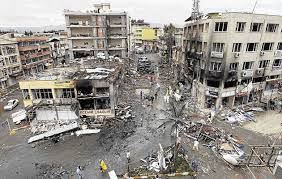
Would you stay here? Source: timeslive.co.za
Sometimes leadership is having these conversations over and over. Calling people forth to their better selves in spite of the fear. These conversations can be like lights that chase out the darkness. It is easier to be brave when we know other people share our concerns and our resolve. Right now the media is amplifying the fear. So those of us who want the end of the story to be different must step up our courageous actions. Counteract the Governor of Georgia who is trying to discourage churches in Atlanta from sponsoring Syrian refugee families. The Governor is proposing legislation to cut off all benefits to Syrian and Iraqi refugees. One church already responded that they will meet whatever needs a family presents. How do we create a welcoming place for them in the midst of this kind of hostility?
This is the challenge posed by the Global Immersion Project. They invited Global Relief to give an overview of the facts. In the 1970s the United States welcomed over 200,000 refugees a year–mostly from Southeast Asia. Last year we let 85,000 refugees in and only a fraction are from Iraq and only 1,682 from Syria. We can do more.
Our screening process is already extremely thorough. First the applicants have to pass the security vetting, then complete the cultural orientation. Then they are matched with a refugee organization. Refugee organizations depend on their local partners who are mainly churches and other volunteer organizations.
The refugees do not get much aid. They have to pay for their own plane tickets via a loan. Then they receive a stipend for 6 months. Generally the refugees–mostly families–are integrated enough to make it on their own. European governments are much more generous and they begin the screening process once you are in country.
The challenge we face is creating a welcome environment for refugees arriving today. With 30 Governors publicly saying that they are not welcome, it is important that people of faith who believe that God calls us to a different kind of hospitality Write and Go.
Vicki from We Welcome Refugees encourages people to make their voice heard either by using the automated system on their website to write to their elected officials or by calling congressional representatives while they are home for Thanksgiving. The electeds’ staff keep a tally and right now voices of compassion are outnumbered by people calling in fear and anger.
The other call is to go: donate coats and household goods or money to refugee organizations, partner with churches in Europe to help refugees, participate with your place of worship to sponsor a family, or be a friend to a refugee. Remember they have left everything they know for life in the United States. Sometimes they are still overwhelmed with concern for the safety of loved ones left behind. Sometimes they are grieving other losses of career or the life that might have been. Or they are just plain homesick.
Source: telegraph.co.uk
As a follower of Christ I welcome refugees as an act of obedience to Jesus’ direction (Matthew 25: 35-39), and because it is the right thing to do. The Golden Rule is not unique to American Christians afterall. And if bombs were turning Sacramento into rubble and I had to flee I would hope that others would welcome me and help me to begin the slow process of rebuilding my life.
I have already sent letters to my Governor, Senators and Congresswoman. I am seeking ways to do more. My congregation is preparing to sponsor families. Wherever they are from I intend to do my utmost to make them feel welcome. Please join me.
An artist’s depiction of Ancient Hebrew Temple in Jerusalem.
My good friend UK Sarah shared the sermon she prepared to preach at St. Phillips Anglican Church in St Heliers, Auckland, New Zealand. I asked if I could share it here. Reading it helped me ground myself amidst the tumultuous emotions in the aftermath of the news of the Paris attacks. I am finding time away from media and spent in meditation instead is helping me get some perspective.
Sermon, Sunday 15.11.15, Reverend Sarah Clare
1 Samuel 1:4-20; Hebrews 10:11-14, 19-25; Mark 13:1-8
‘Will your anchor hold in the storms of life?’
I don’t know about you, but I find these ‘apocalyptic’ passages quite difficult to read. Mark 13 as a whole chapter talks about some frightening end-of-the-world stuff which can seem pretty off-putting to us. But then the shocking events in Paris yesterday were very much in that vein, weren’t they?
Yet I do think there’s an encouraging message for us in today’s passage.
Jesus and the disciples are leaving the Temple… Not some gigantic version of Holy Trinity cathedral, but a vast construction that covered an area somewhere between 35 and 45 acres – roughly the size of twenty football pitches – big enough to fit a quarter of a million people within it, comfortably. [I’ve read that the smallest stones weighed 2-3 tons; some weighed 50. And there’s one still in existence today in the Wailing Wall, that’s 12 metres long and 3 metres high and weighs 100s of tons…! How on earth they ever built it all is beyond my understanding. It was designed to inspire awe; it spoke of majesty and wealth – and God.]
Another artist’s rendering of ancient Hebrew temple.
Anyway, Jesus and his disciples have spent an eventful morning in this amazing Temple. Jesus has managed to answer several theological challenges from chief priests, scribes and elders who are desperate to trip him up. It must have all felt quite scary for the disciples, given the authority these guys had over ordinary people.
So, it’s as they’re leaving the Temple after all this controversy that one of the disciples turns to look at it in all its glory and says, ‘Wow Jesus, just look at those huge stones and buildings!’
Maybe he was relieved that they’d all survived the morning’s encounters. Maybe he needed the reassurance of something solid and secure… like the Temple. That was rock solid – surely? Something to trust. Something that spoke of the enduring nature of God, of His power and might.
So just imagine their shock when Jesus says – ‘Yes it is huge and wonderful. But do you know what? It’s not going to survive; it’s all going to be destroyed.’ What?? It’s literally unimaginable…
Jesus continues this conversation a bit later, when he’s with his inner circle – Peter, James, John and Andrew. By now they’re up on the Mount of Olives, opposite the Temple. Not surprisingly the disciples return to the subject. ‘The Temple’s going to be destroyed? When, Jesus? And how?’
And Jesus has an interesting response, doesn’t he? Because he sees that behind their question is not so much a fear about when all this might happen, but how they are to survive it. So he warns them not to be distracted; a whole bunch of nasty stuff is going to happen – wars, earthquakes, famines, and people pretending to be their saviour- but they shouldn’t let any of this ‘lead them astray’…
Lots of people have studied this passage over the centuries. Some see it as describing the literal end of life, as we know it, some time in the future. Others give it a more contemporary context.
The fact is that at the time Mark was writing his gospel, things were already pretty difficult for the followers of Jesus. They were seeing and experiencing violence, destruction and persecution aplenty. Tacitus, the Roman historian who wrote Histories, gives a vivid description of all the traumas in the Roman empire, man-made and natural, in the middle of the first century. That tells us that Mark might well have been using the current chaotic situation to give people some perspective and remind them of their anchor in the world…
Fast forward 2000 years. Has there ever been a time when there hasn’t been something scary happening in the world? And the horrific terrorist attacks in Paris yesterday are yet another example. More bloodshed. More grief. More fear. One more appalling man-made trauma to add to the long list in my lifetime alone….
And there have also been massive earthquakes, hurricanes and tsunamis across the globe even in the last decade, which have destroyed the lives and livelihoods of millions…
Our world seems to exist in a state of chaos. Our reason tells us that oceans aren’t meant to flood; the earth isn’t meant to shake; the sky isn’t meant to turn nasty and attack us; and humans aren’t meant to kill each other – and yet all these things do happen, over and over again. And when they happen, they destroy our sense of certainty and security….
Our security and our peace, can also be shaken by traumas that happen closer to home, in our own lives. The unexpected can ripfrom us that sense of solid ground beneath our feet. Whether it’s illness, bereavement, or some other tragedy, we can feel buffeted to the ground…. we can lose our sense of direction and perspective.
I think Jesus’ words speak very much to us here today because essentially he’s reminding us that there will be chaos in our lives, there will be trauma; but through it all we need to trust. To have faith.
I heard of a good mnemonic for faith the other day: ‘Feeling Afraid I Trust Him.’ (repeat) ….. Bad stuff will happen, but we are not to let it deter us from following the path he has laid down for us.
And he likens all this to birthpangs. Those of us who have borne children know just how incredibly painful that is! And we have usually had the benefit of modern medicine!!! Imagine just how difficult giving birth must have been in 1st century Palestine. Real pain, real suffering. Jesus isn’t trying to minimise any of this. He knows just how painful all of this can be.
AND YET, in spite of it all, ‘don’t be alarmed’, he says. Don’t be afraid. Don’t be led astray; don’t allow yourself to be paralysed into inaction. Don’t lose sight of what’s really important – who we are, and what we are called to do and be as his followers:-
We are loved by an omniscient God; we’ve been shown how to live lives of faith and grace, loving and forgiving one another, even those we don’t actually like; we’re to be peacemakers, and work for justice for the vulnerable; and we’re to tell others about how Jesus transforms and heals lives. In other words, ‘Remember’, he says, ‘in spite of the chaos, you need to draw strength and hope from these constants in your life.’
Hope, not despair. However challenging the situation we find ourselves in, Jesus reminds us of something that is immeasurably larger than us and this fragile, vulnerable, uncertain, chaotic world we inhabit. Hope in the saving grace of Jesus Christ.
I doubt there’s an adult in this room who hasn’t experienced trauma at some point in their lives. I certainly have. And when trauma hits, it can be hard to see things clearly; everything whirls around our heads, the ground shifts, and it can feel really hard to look up and find our bearings again.
If we allow ourselves to be distracted away from our goal, if we allow fear to get a hold, then it will suck the life out of our veins. But if instead we remember the anchor that holds us – that never-ending faithful and steadfast love that pours out from God – then we can draw on the strength and the courage of Jesus to bring us through….however painful and however difficult it seems.
‘Will your anchor hold in the storms of life? When the clouds unfold their wings of strife? When the strong tides lift, and the cables strain, will your anchor drift or firm remain?
We have an anchor that keeps the soul steadfast and sure while the billows roll, fastened to the Rock which cannot move, grounded firm and deep in the Saviour’s love.’
I pray that the anchor of Jesus Christ holds firm for the Christians in Paris right now, that they might bring strength, healing and hope to a grieving, angry and frightened people.
And may we hold fast to our anchor, as our anchor holds fast to us.
Eyes Wide Open exhibit displays shoes from Iraqi civilians and US soldiers killed in the war.
Yesterday I clicked through an email from the Climate Reality Project to watch 24 Hours of Climate Reality and instead read a message that the broadcast was suspended in consideration of the violence in Paris. This was how I learned of the horror that had been unleashed in coordinated terror attacks. I logged onto the New York Times website and logged off after about 1 minute of watching senseless video of people meandering around the football pitch or police cars speeding down Parisian streets. By now we all know the drill. Lots of senseless interviews with people who know nothing or can say nothing and bad estimates of the extent of the harm. I decided to turn it all off.
What is a leader to do in face of the ongoing violence? Judging by Facebook most people want to DO something. For some it is a primal angry urge to retaliate. Even before information is in about who attacked whom and why. They filled in the blanks by swearing to sign up for military service or in some way extract an eye for an eye.
In this instance, we cannot alleviate our need to DO SOMETHING by donating to Red Cross or Oxfam. Although I would not be surprised if some craven political candidates did not suggest a donation to them would be a welcome response. They promise to deal with ISIS. As though their force of personality will trump the collective intelligence of the people already assembled in Situation Rooms around the world.
Other people were dropping to their knees to pray, mainly for the victims in Paris including all of the citizens of Paris whom these attacks were intended to terrorize. I am among those who feel “pray first” is a good response for almost any situation. Especially while we are still trying to make sense of a situation.
I have been a student of International Relations since the Cold War. Ah, simpler times. Sure we worried about Mutually Assured Destruction but as one character in Madam Secretary said, at least we knew the people on the other side did not want to push the button anymore than we did.
Are the people in the Middle East really such different human beings than us or the Russians? I do not think so. Casting them all as evil villains seems a dangerously simplistic way of dealing with the world.
I believe in the innate value of every human life. I believe we are all imbued with a little bit of God’s spirit. My way of seeing God is through my cultural understanding of Jesus, but I admit that God is bigger than my limited way of seeing Him/Her. I want to be more like Jesus, which means I have to transcend my own petty view of the world and love humankind the way Jesus did. God transcends gender, tribe, nation and religion.
When I look at recent wars in the Middle East, I see a complete lack of compassion for the innocent victims of our aggression. Over 10 years ago, the American Service Friends Committee and others created the Eyes Wide Open exhibit to illustrate the impact of the war in Iraq on civilians. It came to Sacramento’s Capitol grounds and evoked little response. I was opposed to the Iraq war, as I am to initiating any war and I found the exhibit profounding moving. I could not find a way to translate my values into any coherent action.
The challenge I am facing as a leader is to somehow transcend any angry gut response and expand my capacity to love. To mourn the mothers and children, fathers and grandpas who were counted as “collateral damage” in Iraq, Libya, and Syria. I must seek ways to make peace.
I want to find ways to connect with people for dialogue to help move beyond a base level “get ’em” response to something that builds peace. Transformation will not happen in a moment, but we can begin to build a series of moments that will ultimately lead to a shift and then a swerve.
Lack of action on climate change, racial inequality, refuges, gun violence, and the roots of terrorism.–they are all connected to an inability to see the preciousness of every kind of human.
That is as far as my meditation on the Paris attacks have taken me. Will you join me in not taking action today?
One of my work teams is preparing to build a mega infrastructure project. We are thinking through everything from risk registers to organizational charts. At the core of our discussions is an intention to create a work culture that creatively solves problems, asks the right questions, and empowers team members, among other values.
So when I read about Ed Catmull’s book Creativity Inc. about Pixar Animation Studio‘s culture of creativity in Brene Brown’s new book I determined to read it.
The book is worth reading if only for the anecdotes about creating Toy Story and Up. The book has even more value for leaders who want to build work cultures that reflect a team’s values.
Ed Catmull, author of Creativity Inc and President of Pixar Animation Studios.
Here are some of my keepers:
“…we had made the mistake of confusing the communication structure with the organizational structure. Of course an animator should be able to talk to a modeler directly, without first talking with his or her manager. So we gathered the company together and said: Going forward, anyone should be able to talk to anyone else, at any level, at any time, without the fear of reprimand. Communication would no longer have to go through hierarchical channels.” (p. 64) Beyond the communication structure, the company also depended on candor and honesty. This is described in chapter 5. Then as time went on “more and more people had begun to feel that it was either not safe or not welcome to offer differing ideas.” (p. 277) Ultimately they began addressing this with a day long all-employee Notes Day. Their course correction worked. Ed’s candor about not seeing problems, then seeing them, and then solving them, helps me understand how this neverending process works.
The key to making candid communication and problem solving work is described in chapter 6. You have to reduce the fear of failure and to keep critiques from becoming personal. Everyone has to be so committed to the work product that they are willing to put aside hours and hours of work (crumple up whole scripts) for the sake of telling the best story.
There are other gems. I will close with the idea of confirmation bias (p. 181). When team members share viewpoints that are counter to the team’s, the human response is to resist or ignore them because they challenge our mental models. This is very similar to “optimism bias” that has been identified as a barrier to success in infrastructure megaprojects.
PS. The Afterword also has a lovely tribute from Ed to his friend and business partner Steve Jobs that describes his hero’s journey.
At the core of the policy debate about chronic homelessness is our broken mental health system. Chronic homelessness is usually coupled with mental illness. Often the person you may see inebriated on the street is “dual-diagnosed,” that is someone with mental illness who is self-medicating with drugs or alcohol.
As the recent Sacramento Bee article “Genny’s World” by Cynthia Hubert illustrated, every person without a home has a unique story. Some common elements emerge.
They are loved by family, friends and kind strangers who eventually exhaust attempts to get the person help. Mental health and supportive housing is not plentiful enough to make access easy. Especially at early onset of the illness when it will make the most difference. My friend Noel is a smart, capable and resourceful person who became completely frazzled seeking help for a close friend who had a mental breakdown in her 50s. By the time she was able to secure a spot in affordable supportive housing the woman had been victimized by others so that she had no condo, no car, no computers and no other possessions of value. And most tragically no dignity. Noel had succeeded in saving her friend from a death on the street but little else.
Mentally ill people sometimes do not believe they are impaired and need treatment or help. They have a condition called anosognosia and results from damage to the part of the brain that determines self-awareness. As Hubert explains, “It is, according to studies, the second-most common reason that people with schizophrenia decline treatment. The first is the negative side effects of the drugs designed to treat the condition.” One of the most frustrating aspects of advocating for people experiencing homelessness is the countering the common misperception that they want to be homeless.
Mental illness is still shrouded in stigma and ignorance. Some people do not believe in mental illness, characterizing the symptoms as demons. Others choose denial over seeking help because they see it as a character failing or might expose their family to judgement. Many families choose isolation over seeking help. Sometimes people underestimate the seriousness of conditions such as depression.
There are other challenges.When help is sought it is often very difficult to find and pay for it. Often insurance companies dodge providing needed services. Or as someone once told me, “Do not use Kaiser’s psychiatric services–they are more harmful than doing nothing.” Or as a social worker told a friend about a mental health facility: “I would never let anyone I love go to that place.”
Therapies need to improve! As the earlier quote stated, for some people dealing with schizophrenia the side effects from the meds are worse than the symptoms of the illness. And we need to exponentially increase the supply of supportive housing where people can have an apartment home with the social support they need to stay healthy.
As citizens and leaders, what is to be done? And why are we tolerating doing so little? I am going to continue to pursue these questions. Stay tuned.
What comes up when you Google images of mental illness?
I was riding my bike on the American River Parkway, just after the bike/pedestrian bridge crosses the river near C Street. I saw that someone had ripped open full trash bags from the public garbage cans and strewn them across the trail. As I wove my way through the trash I could smell feces and I realized there was a man in full mental breakdown talking to himself about 20 feet off the trail. When he saw me he started swearing the usual derogatory terms for women.
I kept riding, not because I felt at risk, but because I am not equipped to handle his crisis. In the last few years I know mental illness is not a character flaw or demon possession. For the first time I thought of it in the same terms as someone having a heart attack. I would not just keep pedaling. But, who do you call in such a situation?
The Sacramento papers have had too many stories about police responding to a call and shooting unarmed mentally ill persons. I did not want this person to come to harm. And he is not a criminal. Yet, I could not pass by without calling someone because I did worry he might hurt himself.
So I called my two friends who advocate for the mentally ill. I reached Stephanie and she had a couple of suggestions to try before calling 9-1-1. Unfortunately, Loaves and Fishes that is located closest to the person in crisis is open from 8-3 Monday through Friday and not on a Saturday of a three-day weekend. I called 2-1-1, which is the 9-1-1 line for social services. From the menu choices I could tell that this is a great place to call for housing or food for your child under 5, but not for a full-blown meltdown. Then I called the mental health crisis hotline and the woman said she could only help if she could speak to the person directly and get their permission to offer services.
I believe this is the way the law is written to protect the rights of the mentally ill from being locked up in an asylum or forced into treatment. If you have lived in any urban center for long you know when there is someone who is talking incoherently and hitting themselves and walking around nonsensically, that this person is not in a position to talk into a phone to someone who is trying to find them the correct program. Clearly our system is effed up.
My only option remaining was to call 9-1-1. When I called the first operator established the reason for my call and the man’s location and then patched me through to Sacramento Police Department. I found myself holding my breath. I really was not sure I was doing the right thing for the man. I had a hard time explaining his location since the dispatcher was clearly unfamiliar with the bike trail. Ultimately she said she had the information she needed. I was a few miles away by now. Coincidentally I heard sirens immediately and it gave me chills. I would hope the responders who took the call would not use their sirens. I would like to think they have some kind of training for dealing with someone with mental illness.
Why is it that if someone on the trail was having a heart attack and I called 9-1-1 they would send an ambulance, but with mental illness they sent the police. And the police most often take the person to jail. This man, caucasian early 30s, was somebody’s son, somebody’s brother. And even if he is completely alone in the world, he is a child of God.
What is a good Samaritan to do?
P.S. I wrote this 5 months ago and waited to publish it. I wanted to be able to offer some kind of solution. Then today The Sacramento Bee started a series by Cynthia Hubert on homelessness and mental illness. I am going to move back some of my posts to focus on the issues brought up by this series.
Tone of voice can communicate volumes, or completely confuse. For example, today I was cycling home from a work meeting. I am waiting at the light on K Street. I look across the street and a car has pulled into the right lane facing me. He plans to turn as though he is on a one way street, although it is two-way. I am very worried someone will turn left off of 15th Street and into him. I am grimacing every time a car on 15th approaches the intersection. I cannot tell if the person realizes what they are doing wrong.
The light changes at last and I wait for the car going the wrong way to turn. although since I am going straight I technically have the right of way, there is literally nowhere to safely ride. The car in the correct lane of oncoming traffic rolls down their window. I slow to make sure they are not also turning. The driver yells at me, “Thanks for obeying the traffic laws.”
Now, just looking at the surface events I would accept the compliment and realize that the other driver’s behavior stressed him out too. Except the driver’s tone had the opposite impact. First he’s shouting. Also he sounds snide, almost drippy sarcastic. I have to think through the situation and assure myself that I was abiding by traffic laws.
If the driver intended to praise me, his tone undercut his intentions. This happens to me a lot more often than I would like. I can tell that the way a comment landed that it did not have the desired intention. Most often it is because the tone did not match my message, thus taking on a completely different meaning. The best I can do is to quickly repair with an explanation and an apology or clarification.
In my example, it is literally a “drive-by’ comment. I will never see this person again. I will never know for sure what the driver’s intentions were. I can only shake off the stress and remind myself to be impeccable with my words, including my tone.
Sarah Harriet and I watched the movie He Named Me Malala at lunchtime and I have been emotionally fragile ever since. I boo-hooed through the movie, especially when Malala met with Nigerian parents of kidnapped schoolgirls and whenever they showed girls around the world eager to learn in school.
He Named Me Malala is a powerful film because it so beautifully shows the special bond between Malala and her father Ziauddin. It raises the question of whether Malala would have spoken out if not for her father. Malala answers that question for me: she would not be who she is without her special parents and she made her own choices to speak out. She is also being who God created her to be.
I appreciated the opportunity to see film clips of Malala publicly advocating for girls’ education before the Taliban attack. She elected to be a spokesperson even before she became world famous.
Malala embodies courage and her story is hugely inspiring. The film also gives a non-stereotyped view into Muslim life in Pakistan. Davis Guggenheim made great directorial choices including illustrating some of the foundational stories in pastel animation. They matched the narrative tone.
Overall, his greatest gift is in gaining Malala’s family’s confidence, thereby giving us a more intimate profile in courage.
Malala’s dedication to the 63 million girls who are out of school is remarkable. It is also a cause we should all support. So much good comes from girls’ education. Worried about over population? There is a strong correlation between girls’ education and falling birth rates. Worried about poverty? There is a strong correlation between girls’ education and family well being.
You can support international girls’ education through The Malala Fund. Or through a number of other organizations working toward the same cause: Camfed, CARE, and World Vision.
P.S. There was a powerful trailer for the movie Suffragette shown before the feature. It looked like it is going to be great and I am not sure I will be able to watch: INTENSE!









 leader's compass